Meet Alex, he just spent most of his career in telematics in Europe. He knows how the infrastructure works: sensors, connectivity, billing, the operational headaches. Now he’s co-founded a fleet-software startup. He remembers the old days: a customer wants to know where their trucks are, get some reports, maybe geofence alerts, and that was good. But today things have changed.
And if you are like Alex or if you run a telematics business in the Middle East, or are a former telematics exec looking to expand into fleet software, you’ll need to face this new reality too: The market doesn’t just buy software that shows “where the vehicle is.” They want “what should we do about it,” fast and with minimal fuss.
Imagine your customer Maria, managing a fleet of long-haul trucks across the EU or Gulf region. Her biggest headache?
When one truck breaks down or is delayed, she wants to fix it now, not wait for a daily report to tell her tomorrow.
In the past, a traditional telematics provider would give Maria:
- GPS location of the truck
- A dashboard with speed, idle time, driver behaviour
- A weekly report that summarises performance
That was fine.
But now her boss says: “Show me how we will reduce breakdowns, save fuel, avoid accidents”.
The CFO wants proof, not just data.
She doesn’t want “Your truck idled 25% of the time last week”, she wants “We’ve automatically alerted driver Jane to move to the optimal route now, saved 12 minutes, avoided toll delays, and reduced idling by 8%.”
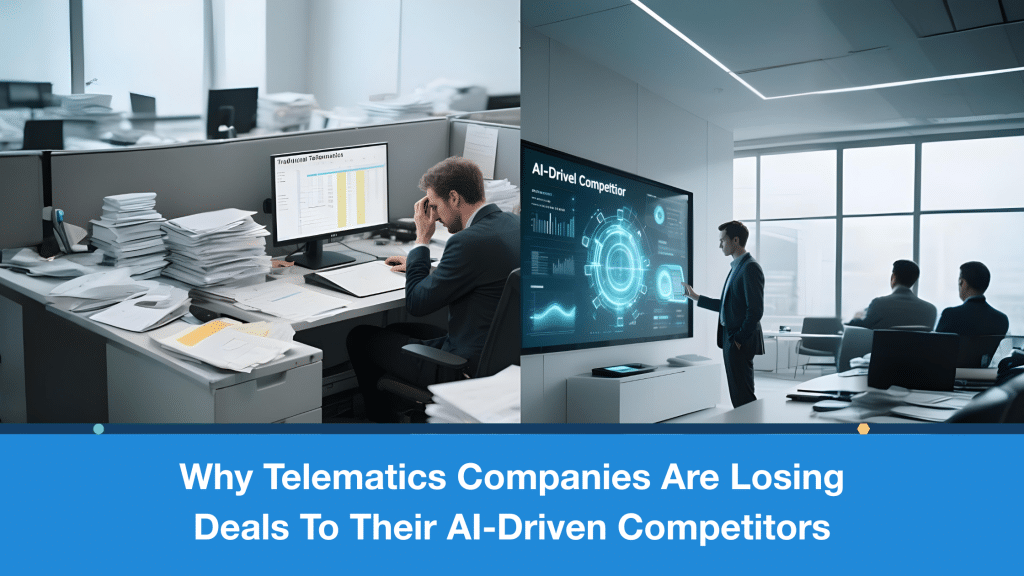
In short: the value is in action, not merely insight. And that’s where the AI-driven telematics rivals are stealing deals.
What the new competitors do differently
If you strip away the buzz, here’s what the AI-first guys are doing:
- They ingest everything: vehicle telemetry + camera video + weather + traffic + maintenance logs.
- Then they predict things: “this engine fault will arise in the next 200 hours”; “this driver will likely engage in a harsh braking event this month”.
- Then they prescribe or automate: “reroute this truck now”; “coach this driver immediately”; “schedule this truck for service before the next job”.
- They wrap it in a story: “Here’s your expected ROI; fewer accidents, lower downtime, driver retention”.
- They show up to bid and say: “We guarantee you X% fewer incidents in 12 months.”
An example of such AI companies serving the EMEA, LATAM and North America region with their AI first telematics platform is ZenduONE which also offers private label solutions that ensure that you cut down go-to-market time and cost by at least 83%.
Compare that to the traditional approach: “Here are the dashboards. You tell us what to do.”
When Maria chooses a provider, she picks the one that promises less work for her, better business outcome, faster payback. And that’s why many legacy telematics players are coming in second.
And the reality you face, whoever you are
As someone who knows telecom, connectivity and sensors, you have a huge advantage. You understand device roll-out, data flows, billing models. But if you stop there, you’ll slowly become a commodity provider (just “device + data + dashboard”). In the EMEA region especially (Europe, Middle East, Africa) the competition is heating up:
- Fleet managers face rising costs (fuel, driver wages, regulation). So they want more value for money.
- They expect compliance and data-governance built-in (especially Europe with GDPR/equivalents). They don’t tolerate risky data practices.
- They want integrations (with ERP, with OEMs, with insurers) and don’t want a silo.
- They are becoming sceptical about “nice dashboards”, they now ask: “Will this solve my downtime or prevent my next accident?”
So if you’re launching or expanding a fleet software business, you need to align with those market realities.
How?
Here’s a simple roadmap that factors in time to go to market, financial and human resources ensuring that you don’t stay building for 1 year:
1. Start with a clear customer story
Pick a niche: e.g., last-mile delivery fleets in Dubai, or regional logistics fleets across Europe.
Ask: What is their biggest pain? (Breakdowns? Driver safety? Fuel costs?).
Then frame your solution: “We will cut your maintenance hours by X per truck per month.”
2. Offer action-not-just-data
Don’t sell “dashboard + report”.
Sell “we alert the driver / dispatcher when there is a risk, and we will automatically reroute / reschedule service / reduce idling”.
Design for minimal clicks and minimal manual interpretation.
Your best bet for this? ZenduONE
3. Use your telecom/sensor experience for good
You know how to roll out devices, manage connectivity, scale updates.
Use that to build cheaper, reliable hardware or partnerships. But pair it immediately with AI-capable software.
Get the data flowing and ensure your platform can handle real-time events, not just periodic uploads.
4. Build a performance model and prove it
Set up a pilot: “6 weeks, 20 trucks, we reduce idling by at least 10%”.
Collect data, measure before/after. Use this in your sales deck to compete.
5. Ensure compliance & data governance
If you’re operating in Europe or the Gulf, make sure data consent, storage, cross-border flows are thought through. This is now table stakes.
Better yet, treat it as a feature, “we give you compliant data for your insurers, OEMs and regulators”.
6. Price for outcomes
Instead of billing per device or seat, offer a model linked to the outcome: “we save you X € per month”, or “we guarantee fewer incidents”. This introduces a monthly subscription model that enables residual income flow for you and also aligns your incentives with the customer’s.
Your telecom background probably gave you subscription models; now tie them to business metrics or better still, since ZenduONE is your private label partner, request for the subscription model too. No stress, no delays!
Now the story can spin in your favor
Maria is the fleet manager for a regional food-distribution company in Spain. Her trucks must deliver to many small towns, and time is money (fresh produce). Last month, one truck broke down midday; the frozen load spoiled; waste cost €4,000; the customer was upset.
She has held the legacy telematics provider for years. They show her the breakdown: “Truck #47 idled excessively last week, engine coolant temp rose, driver speed variance was high.” She got the report but by then the damage was done.
Enter your company, the super hero of the story. You show Maria this: “We integrate the engine CAN data and video feed. We detect when engine coolant temp rises above threshold AND truck is more than 30 minutes from scheduled stop. We send real-time alert to dispatcher: ‘Pull over truck #47 now, cooler off, schedule maintenance immediately.’ The system also optimises the next route to pick up emergency replacement, and the driver gets an instant message. In 2024 pilot we did this with another fleet and reduced breakdowns by 23%. The payback was in 4 months.”
Maria asks: “How much does this cost?” You say: “We charge €X per truck per month, but only if we reduce your maintenance cost by more than €Y. Otherwise you don’t pay the difference.”
She signs up. Next month, a truck shows the coolant warning. The alert triggers. Maintenance is done overnight. The load is saved. Maria sends you the thank-you email and her boss nods approvingly.
The legacy vendor? They still offer reports, but Maria already switched. They lost the renewal because they didn’t automate the fix, they only reported the symptom.
If you’re in fleet software, especially coming from telecom or hardware/sensor roots, remember:
The buyer is now paying for what the system does, not just what it shows.
Your job is to link connectivity + telematics + sensors + AI into a workflow that visibly improves business outcomes.
Otherwise, you’ll find yourself being “the old vendor” in a world moving fast.